
TexasBob.com
| Home | Texas Historical Documents | Texas Books | Genealogy | Texas Bob Travels | Oil Patch Tales | Texas High School Football | Chuck Wagon | Quilts | Texas Greeting Cards | Texas Coloring Sheets | Texas Post Offices | Texas Counties | U.S. Historical Documents | Page Links | Site Map | Email Texas Bob | Texas Bob's Texas Crafts | Texas Football Stadium Database | Texas RV Parks  |  Texas Bob's Activity Center | Texas Bob Eats | Texas Calendars | Texas Music | Texas Children's Books | Texas Bob's Blog | About Me |

Texas Bob Travels Home

Odessa Meteor Crater

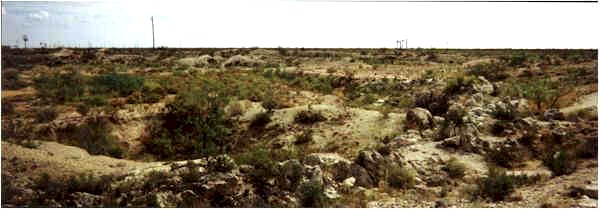
Crater
The "Crater"

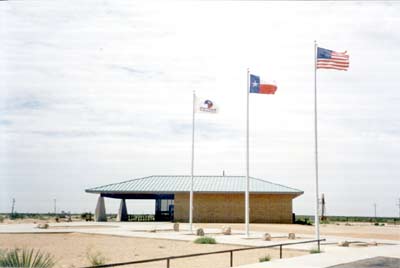
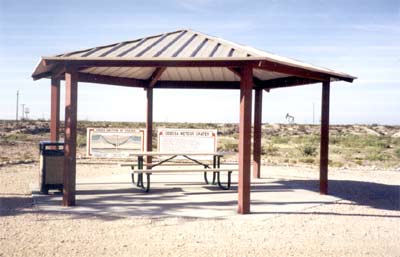
Odessa Meteor Crater Visitors Shed
Visitors shed, complete with printed brochure.  Believe me this is an improvement over my last visit.

Directions:
  Approximately 4 miles west of Odessa, Texas on Interstate 20.  Exit FM 1960, crossover I-20 and across the railroad tracks.   Turn right, follow signs.

Texas Bob Communes with the "Crater"

Since I was born and raised just a few short miles from the infamous "Crater" I had to include it my "Travels".  The "Crater" can only be appreciated by the serious meteor junkie.  The road was well paved and the parking area had two cars in it when I arrived.  That's a lot just to see a hole in the ground.  There are brochures available at the visitors shed and the a well mark trail runs through the "Crater" and up the west rim and back.  The trail has very good markers describing the various features.

Right in the middle of the crater is a 165 foot deep shaft that was dug by the WPA during the depression.  They were looking for the meteorite, estimated at 70 tons, that caused this depression.  They didn't find it.  It is now known that the meteorite was traveling at such a high speed it vaporized on impact. 

The shaft  was lined with timber as it was dug.  Sometime in the early 1950's somebody threw a lit tumble weed down the shaft to get a better look.  The timbers caught fire and the shoring was all destroyed.  The shaft is  now sealed with a cement cap.

Before I left a I had the opportunity to talk with Japanese tourist "Akima".  I asked her, "Why did you come to  the Crater?".   She told me, "I heard about this place and wanted to see it".

"TOUCHDOWN!!" Odessa Convention & Visitors Bureau.

Odessa Meteor Crater

has been designated a

National Natural Landmark

This site possesses exceptional value
as an illustration of the Nations
heritage and contributes to a better
understanding of the environmental
1965
National Park Service
United States Department of the Interior.

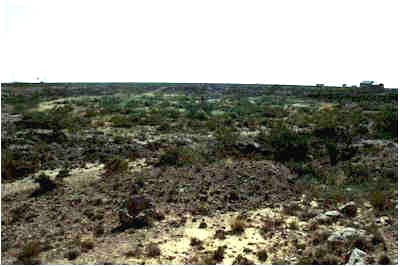
Odessa Meteor Crater
The "Crater", you have to be there to appreciate it.

Odessa Meteor Crater
Japanese tourist "Akima" traveled from Dallas to see the "Crater"

Historical Marker
Odessa Meteor Crater

The Odessa Meteor Crater, second largest in the United States and sixth in the world, was formed some 20,000 years ago when an iron meteorite believed to weigh 1,000 tons crashed into the earth near this site. Impact was so great that 4.3 million cubic feet of rock was expelled or shifted, forming a cone-shaped crater 500 feet wide and nearly 100 feet deep.

Action of wind and water during subsequent centuries filled the cavity with silt so that today its concave surface is only five to six feet below the level of the surrounding plain. It retains its original broad diameter, surrounded by a low, rock-buttressed rim created when limestone formations were shattered and forced to the surface by the burrowing mass.

Fragments of the meteorite collected around the crater indicate that it was 90 per cent iron, with small amounts of cobalt, copper, carbon, phosphorus, sulfur and chromium. Although the mass has never been found, it is believed to lie embedded 179 feet below the surface. In addition to the principal crater, scientific investigation has revealed the presence of smaller adjoining depressions, formed by less massive bodies that fell in the same meteor shower which sent the large mass to earth. Although not now discernible, they were from 15 to 50 feet wide and from seven to 17 feet deep. Neither penetrated deeply enough to encounter solid rock but was formed primarily in clay-like deposits.

Meteors are believed to have been formed by the breaking-up of a planet similar in size and composition to the earth. The body is thought to have been part of the solar system... perhaps the mythical planet between Mars and Jupiter whose disruption must have created the asteroids.
(Historical Marker)


Contact Texas Bob
Last Update  05/24/08 08:38:27 PM
Privacy Policy
© 1998 - 2008  All Rights Reserved R. McSpadden